Most of my research has been focused on determining the compositions, sources, and fluxes of aqueous fluids in metamorphic terrains. Supercritical fluids are the primary agent of differentiation in the Earth's crust and are responsible for the transport of mass leading to the formation of ore deposits. Fluids are also capable of transporting significant quantities of energy and play a direct role in the evolution of magmatic arc terrains and other regions where magmatic heat is transported to the surface.
My students, colleagues, and I have been studying fluid–rock interactions both in the field and in the laboratory. Peter Nabelek, University of Missouri, and I began these studies at Notch Peak, Utah, and extended them to the Panamint Mountains, California. I, myself, was introduced to the importance of metamorphic fluids in the contact-metamorphic aureole of the Duluth Complex, Minnesota. I have also been studying mineral–fluid reactions in the laboratory in dolomite–H2O and olivine–H2O systems with Dave Cole, Oak Ridge National Laboratory. Larry Anovitz and I are also determining solubility and phase relations in the system H2O–CO2–NaCl. Here are summaries of some of these studies.
Fluid–Rock Interaction at Notch Peak, Utah
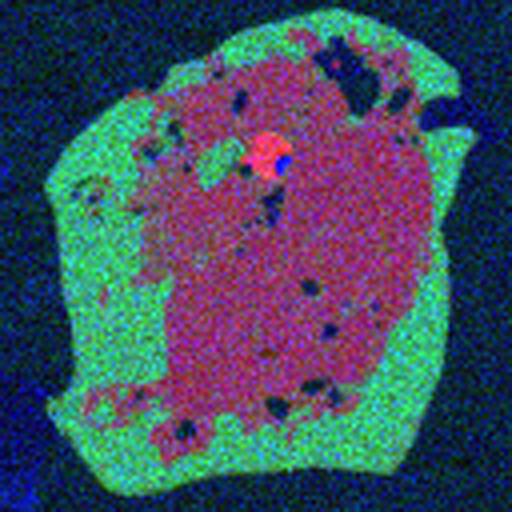
Barium distribution in alkali feldspar from the Weeks Limestone Member. Celsian in pink is surrounded by hyalophane in magenta and K-feldspar in green.
The Middle Jurassic Notch Peak stock is a quartz monzonite stock that intruded Lower Cambrian limestone and argillaceous limestone in west–central Utah. The petrology of the metamorphosed carbonate rocks was studied by Vicki Hover and Jon Novick. Peter Nabelek measured C and O isotope compositions of the limestone and argillite and found significant depletion in the δ13C and δ18O in the high-grade argillites. The nearly pure calcite limestones, however, showed no change in delta values. With the existence of wollastonite in the argillites, Peter and I concluded that the argillaceous rocks were host to a large volume of water, probably exsolved from the crystallizing stock; whereas, the limestone marble was impermeable.
Metamorphic Fluid–Rock Interaction in the Noonday Dolomite, California
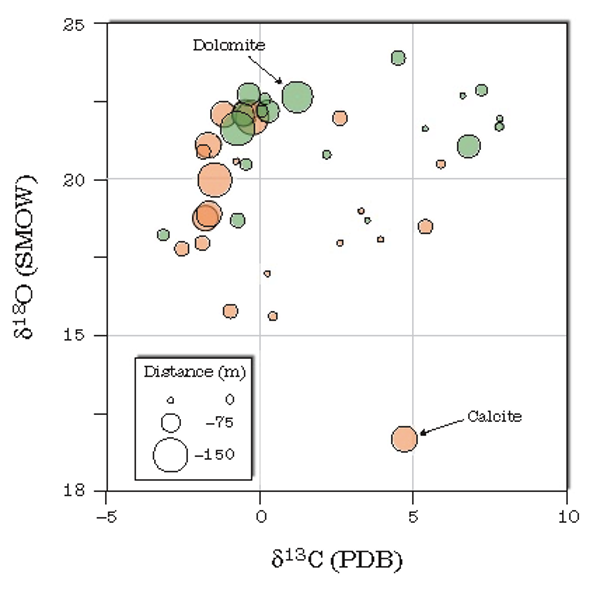
Correlation between O and C isotopic composition in calcite and dolomite from the Noonday Dolomite. Bubble size represents the stratigraphic position of the samples.
A lot of my work has been conducted in the regional metamorphic terrain in the Panamint Mountains, California. A description of the geology of the Telescope Peak Quadrangle was given by Labotka, Albee, Lanphere, and MacDowell (1980)
Three rock units near the head of Wildrose Canyon have assemblages that indicate distinct fluid compositions. These are the Late Precambrian Kingston Peak Formation, the Noonday Dolomite, and the Johnnie Formation. The Kingston Peak Formation contains a variety of rock types, mostly argillite, graywacke, and conglomerate. Assemblages in the argillite indicate a very water-rich environment. The Noonday Dolomite reacted with a carbonated fluid, and the Johnnie Formation shows evidence for a fluid that changed composition from carbonated to water-rich during metamorphism. Peter Souza measured the C and O isotopic composition of the top part of the Noonday Dolomite. The graph on the left shows the composition at different stratigraphic levels. The top of the formation originally had a high value of δ13C; whereas the lower part had an original value of ~ 0. During metamorphism, both the C and the O decreased in delta value as a result of the influx of an isotopically light fluid, possibly from the Kingston Peak Formation, beneath.
Experimental Studies
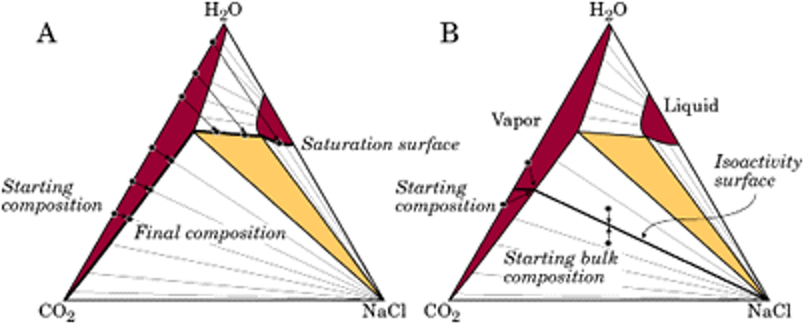
Phase diagram for the system CO2–H2O–NaCl at 500 °C, 50 MPa, showing two kinds of experiments.
Larry Anovitz and I have been studying the thermodynamic properties of the system H2O–CO2–NaCl at temperatures and pressures above the critical curve. The system is a good model for the behavior of crustal fluids at moderate depths in the Earth’s crust. We measure the solubility of NaCl in the fluid system at a fixed value for the activity of H2O in an internally heated pressure vessel. We are trying to determine the thermodynamic mixing properties from the experiments and then to apply them to the study of fluid–rock interaction in metamorphic and hydrothermal environments.
As an example, we have looked at the consequences of the volume of mixing on the pressure and reaction progress in carbonate rocks. Decarbonation reactions in the presence of an aqueous fluid increases the pore pressure tremendously, not only because of the addition of moles of CO2, but also as a result of the nonideal volume of mixing.
Recent References
Labotka, T. C., and Souza, P. A. (2012) Coupled isotope exchange and mineral reaction during metamorphism of the Noonday Dolomite, Panamint Mountains, California. Contributions to Mineralogy and Petrology.
Anovitz, L.M., Labotka, T. C., Blencoe, J.G., and Horita, J. (2004) Experimental determination of the activity–composition relations and phase equilibria of H2O–CO2–NaCl fluids at 500 °C, 500 bars. Geochimica et Cosmochimica Acta 68, 3557–3567.
Labotka, T. C., Anovitz, L. M., and Blencoe, J. G. (2002) Pore pressure during metamorphism of carbonate rock: Effect of volumetric properties of H2O–CO2 mixtures. Contributions to Mineralogy and Petrology, 144, 305–313.
Labotka, T. C., and Kath, R. L. (2001) Petrogenesis of contact-metamorphic rocks beneath the Stillwater Complex, Montana. Geological Society of America Bulletin, 113, 1312–1323.
Labotka, T. C., Bergfeld, D., and Nabelek, P. I. (2000) Two diamictites, two cap carbonates, two δ13C excursions, two rifts: The Neoproterozoic Kingston Peak Formation, Death Valley, California: Comment. Geology.
Labotka, T. C., Souza, P., and Nabelek, P. I. (2000) Coupled mineralogic reaction and isotopic exchange in regionally metamorphosed dolomite, Death Valley, California. Goldschmidt Conference.
Student Theses
Kelly Plummer, MS 2005, Contact metamorphism at the Belmont pluton, Toquima Range, Nevada.
Ian Richards, PhD 1994, Role of Fluids during Mesozoic Metamorphism near Lone Mountain, Nevada.
Peter Souza, MS 1991, Fluid-Rock Interaction during Mesozoic Metamorphism of the Proterozoic Noonday Dolomite and Johnnie Formation, Panamint Mountains, California.
Jonathan Novick, MS 1987, Metamorphism of the Weeks Limestone, Notch Peak, Utah: The Low-Grade Reactions and Fluid Inclusions.