The rates and mechanisms of reactions between aqueous fluids and rocks are being determined experimentally by me and colleagues at the Chemical Sciences Division of Oak Ridge National Laboratory. L. Anovitz, J. Blencoe, D. Cole, M. Fayek, and L. Riciputi are determining the thermodynamics of the system H2O–CO2–NaCl, the diffusivity of C and O in carbonate minerals, the kinetics of reactions in the system CaMg(CO3)2–H2O–CO2, and C and O isotopic exchange between calcite and H2O–CO2 fluid.
Breakdown of Dolomite in mixed-volatile fluid
Grain-Scale Experiments
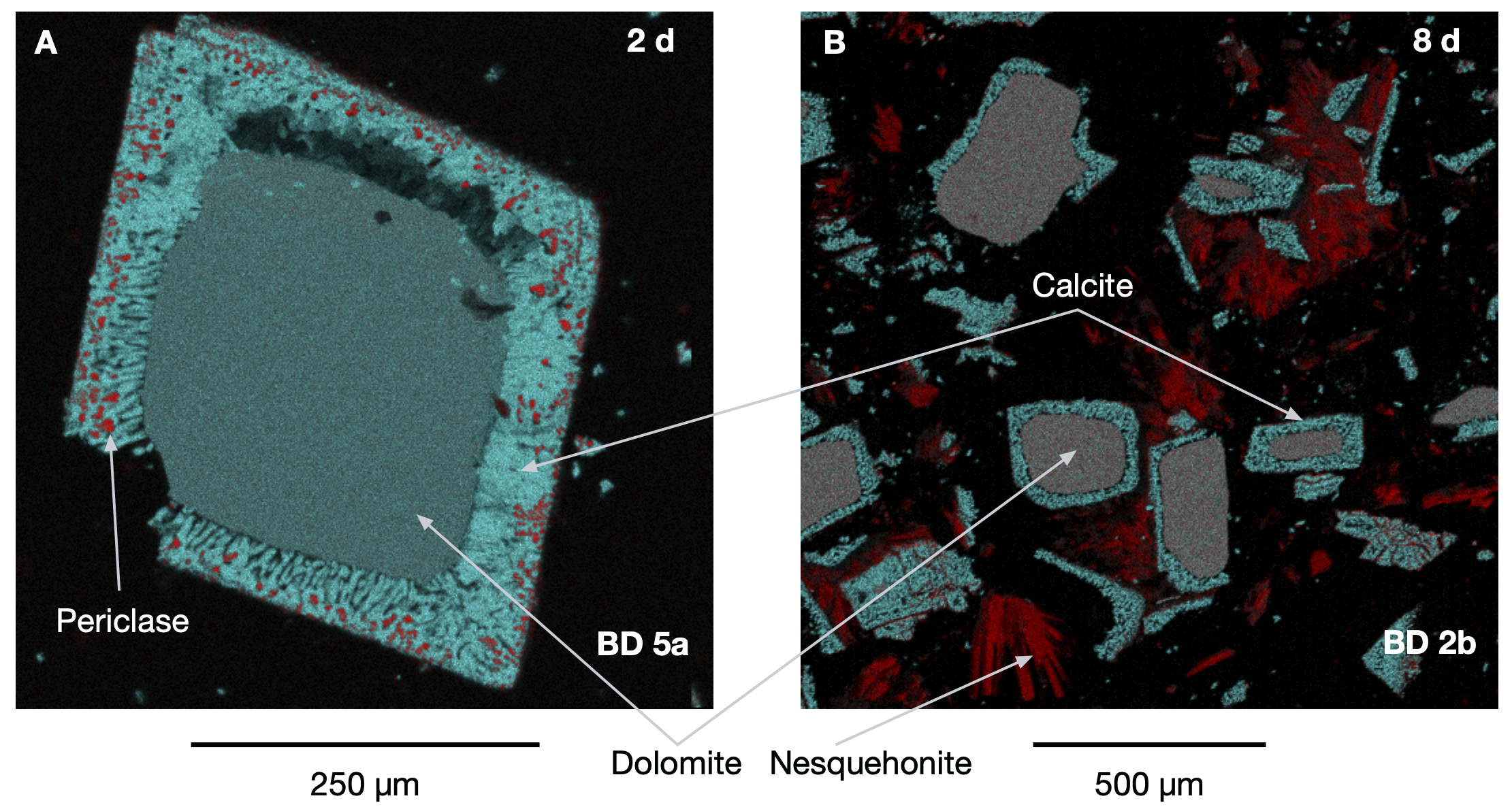
Micrographs of selected grain-scale experiments after experimentation. The images are x-ray micrographs with Mg Kα in the red channel and Ca Kα in the green and blue channels. Calcite grains are bright cyan, periclase is red, and dolomite is dull cyan. Nesquehonite is dull red. (A) BD 5 was reacted for two days at 700 °C and 100 MPa. (B) BD 2 was reacted for eight days. Periclase is either concentrated at the rim as in (A) or is absent from the rim as in (B). Pores are abundant throughout the reaction rim.
The occurence of periclase in contact-metamorphosed dolomite rock at modest temperature and pressure indicates an infiltration of H2O because of the otherwise high temperature required for the reaction dolomite → periclase + calcite + CO2. We conducted experiments on the breakdown of dolomite in the presence of H2O at 700 °C, 100 MPa. Grains of dolomite, 175-250 μm in radius, were heated for up to thirty-two days (32 d). Rims of multigrain calcite and periclase formed around dolomite cores with ∼ 50% of the dolomite replaced by 32 d. The growth of the rim is similar to that for previous experiments conducted with cores of dolomite rock and follows a square root of time relation. The decrease in dolomite-core radius with \(\sqrt{t}\) suggests that the rate is controlled by diffusion of CO2 and H2O through the reaction rim. The results can be modeled by the topochemical or “shrinking-core” model, in which the unreacted grain core shrinks as \(r = r_0 -\sqrt{\kappa t}\) with a kinetic parameter \(\kappa\) of 6.76 ± 0.6 × 10⁻⁴ μm2/s (0.0213 mm2/y). The model predicts that dolomite grains of up to 2 mm in radius would disappear in < 200 y. In a rock undergoing metamorphism at the conditions of the experiments, the reaction zone grows to a width ranging from < 2 mm to > 800 mm, depending on the radius of the grains in the rock. The porosity grows rapidly, and CO2 is released abundantly at the beginning of reaction near the leading edge of the periclase isograd. The shrinking-core process occurs as long as the intergranular fluid is H2O rich, requiring a modest, minimum flux sufficient to displace the evolved CO2. The common replacement of periclase by brucite observed in nature was not seen in our experiments. Rather, the quench phase was the magnesium-carbonate hydrate nesquehonite, suggesting the brucite forms only in very CO2-poor fluid.
Rock-Scale Experiments
Dolomite rock, 4 mm across, reacted with H2O at 700 °C, 100 MPa.
Metamorphism of carbonate rock is commonly the result of reaction between the minerals in the rock and an H2O-rich fluid. One example is the breakdown of dolomite, producing calcite + periclase. The reaction results in a reduction of the solid volume of the rock and a production of CO2. Both contribute to the increase in permeability during reaction, permitting continued ingress of H2O. We have attempted to determine some of the processes that occur during infiltration and reaction experimentally. We cut 4 mm diameter cores of dolomite rocks with a variety of textures ranging from fine-grained sedimentary dolostones to coarse-grained dolomitic marbles. Experiments are carried out using a conventional cold-seal hydrothermal apparatus. The dolomite rock cores were sealed in gold capsules with an aliquot of isotopically enriched water of composition HD18O0.516O0.5. The samples were held at a P = 100 MPa and T = 650–700 °C for durations ranging from a few days to a few months.
After experimentation, the cores were sectioned and examined by XRD, EMP, SIMS, and CL techniques. All experiments show some reaction, even in experiments lasting for only two days. In samples with a large water-rock ratio, complete reaction occurred within 30 d at 700 °C. Crystallization of new mineral phases within coarse samples is concentrated along fluid infiltration pathways, such as grain boundaries and fractures. Smaller grain size samples show more pervasive crystallization, with original dolomite nearly completely replaced by calcite. Although periclase is the stable phase for the conditions of these experiments, extensive brucite is observed and is believed to be the result of rapid hydration of periclase upon quench. SIMS ion imaging shows extensive enrichment of 18O along dolomite grain boundaries and in fractures. There is little evidence in the short-duration experiments for any exchange between fluid and the dolomite, but the newly formed products of reaction are strongly enriched in 18O. Under the conditions of the experiments with water–rock ratios > 1, grain-boundary transport readily occurs over the sample distances of 2–4 mm.
Isotope and cation exchange in alkali feldspar
Amelia albite (red) surrounded by K feldspar (cyan) reacted with a KCl solution.
Nanoscale isotope and chemical images of grains of Amelia albite that were reacted with 2 M 18O-enriched solution of KCl show a correspondence between O-isotope exchange and K–Na exchange. Experiments were conducted for 4–6 d at 600 °C and 200 MPa. After 6 d, the 150 μm diameter albite grains had 5–20 μm rims in which Na was nearly completely replaced by K and in which the O was strongly enriched in 18O. The boundary between the core albite and the K-feldspar replacement is sharp and decorated with numerous pores. The distribution of Na and K, determined by electron probe microanalysis, is uniform within the core and rim and has an abrupt discontinuity at the interface. There is no evidence for K–Na interdiffusion at the resolution of electron probe. The NanoSIMS shows that the interface is also sharp in the distribution of 18O and 16O. The NanoSIMS image data and the electron probe data were coregistered; principal components analysis of the merged data set shows that 86% of the total variance in the data result from a single principal component loaded by the replacement of Na by K and 18O. The combined electron probe and NanoSIMS analyses indicate that both cation and isotope exchange occurred during solution and reprecipitation of the feldspar.
Diffusion of C and O in carbonate minerals
Diffusion of C and O in calcite at 100 MPa
Depth profile of 18O and 13C fractions in calcite, measured by SIMS.
The diffusivities of C and O in calcite were determined in a pure CO\(_2\) atmosphere at 100 MPa and temperatures ranging from 600 to 800 °C. The calcite crystals were preannealed and H\(2\)O was excluded from the system to determine the self-diffusion coefficients. The CO\(_2\) consisted of 99% \(^{13}\)C and 90% \(^{18O}\). After heating for 7–147 d, diffusion profiles were measured with the use of secondary ion mass spectrometry. The results indicate that the diffusivity of C is \(D_{\text{C}} = 7.77 \times 10^{-9} \exp (–166 ± 16\text{ kJ/mol/RT})\) cm\(^2\)/s and of O is \(D_{\text{O}} = 7.5 × 10^{–3} \exp (–242 ± 39\text{ kJ/mol/RT})\) cm\(^2\)/s. In comparison with other determinations of diffusivities in calcite, diffusion of O under the experimental condi- tions is consistent with vacancy migration in the intrinsic region, and diffusion of C seems to occur by diffusion of carbonate anions. Increased pressure appears to reduce the activation energy and the value of \(D_0\), and the presence of H\(_2\)O greatly increases the diffusivity of O without appreciably changing the activation energy. Closure temperatures calculated for isotopic exchange by diffusion predict that C isotope compositions of calcite are preserved during cooling in most geologic environments, but that O isotope compositions in H\(_2\)O-rich environments are preserved only in rapidly cooling environments, such as contact metamorphic aureoles.
Diffusion of C and O in calcite from 0.1 to 200 MPa
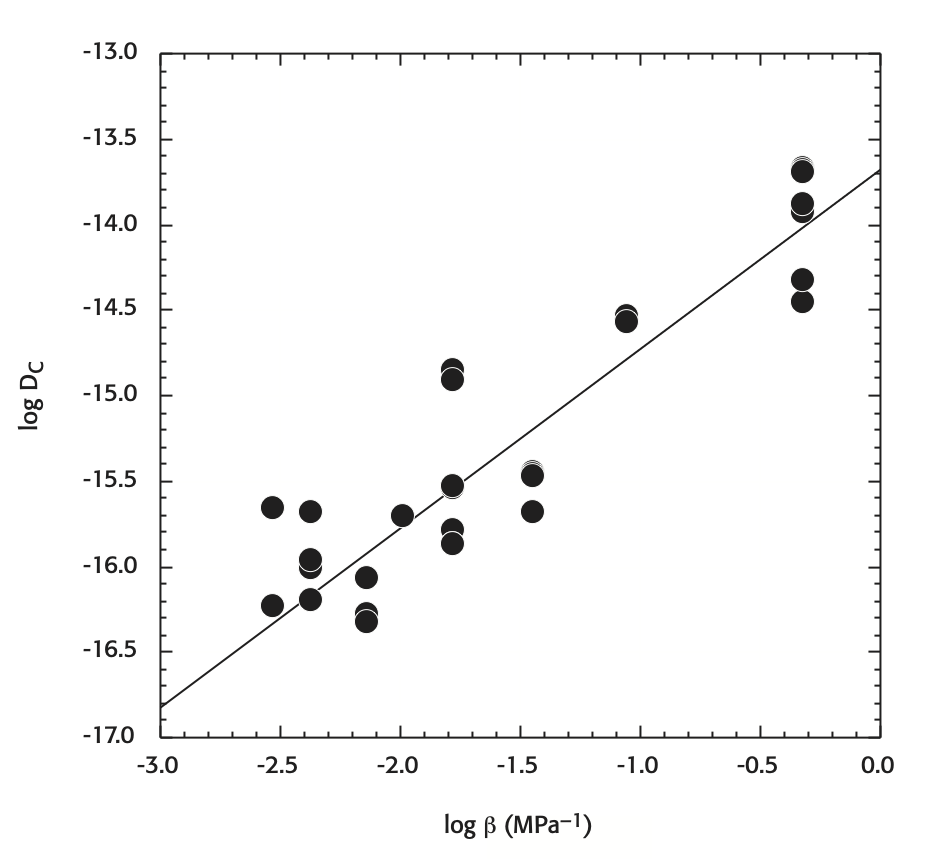
Correlation between the observed \(D_\text{C}\) and the compressibility of CO2. The straight line has a correlation coefficient of 0.9.
We measured the diffusivity of C and O in calcite over the pressure range 0.1–200 MPa at 600–800 °C in a pure CO\(_2\) atmosphere. The experiments were conducted on single, preannealed crystals of Chihuahuan calcite in an isotopically labeled atmosphere, and the diffusion profiles were measured by secondary ionization mass spectrometry (SIMS). At 800 °C, \(D_{\text{C}}\) and \(D_{\text{O}}\) are identical at 0.1 MPa at a value of \(\sim 10^{–13.5}\) cm\(^2\)/s. The value of \(D_{\text{C}}\) decreases to \(\sim 10^{–16}\) cm\(^2\)/s with an increase in pressure to ~ 50 MPa and remains at that value to 200 MPa, but \(D_{\text{O}}\) remains nearly constant at a value of \(\sim 10^{–14}\) cm\(^/\)s to 200 MPa. The identical values at low pressure indicate that C and O are migrating together as a carbonate anion. A simple model relates the diffusivity of carbonate anions to the formation of vacancies at the crystal surface, which predicts that \(D_{\text{C}} \propto 1/f_{\text{CO}_2}\). The prediction matches the observed decrease in \(D_{\text{C}}\) with increasing pressure to 50 MPa. The shapes of the diffusion profiles for the low–pressure experiments indicate compositional dependence of D, which also suggests the influence of CO\(_2\) sorption on the diffusivity. The value of \(D_{\text{C}}\) at 0.1 MPa can be fitted to the relation \(D_{\text{C}} = 0.62\ \exp{(–291\text{ kJ/mol}/\text{R}T)}\). The activation energy is nearly twice the value determined for \(D_{\text{C}}\) at 100 MPa, \(\sim 166\) kJ/mol. The change in slope for \(\log D_{\text{C}}\) vs. \(P\) and the change in \(E_{\text{a}}\) between 0.1 and 100 MPa suggest that the migrating C species changes from carbonate anions at low pressure to carbon atoms at \(P \ge 50\) MPa. The values of \(D_{\text{O}}\) at 0.1 MPa can be fitted to \(D_{\text{O}} = 0.017 \exp{(–261\text{ kJ/mol)}/\text{R}T}\), approximately the same as for C at 0.1 MPa and similar to the relation for \(D_{\text{O}}\) at 100 MPa: \(D_{\text{O}} = 0.008 \exp(–242\text{ kJ/mol)}/\text{R}T)\).
Some Recent References
Labotka TC, Cole DR, and DeAngelis MT (2025) An Experimental Study of the Breakdown of Dolomite in H2O at 700 °C, 100 MPa. American Mineralogist 110, 845–855.
DeAngelis, M.T., Rondinone, A.J., Pawel, M.D., Labotka, T.C., and Anovitz, L.A. (2012) Sol-gel synthesis of nanocrystalline fayalite (Fe2SiO4). American Mineralogist 97, in press.
Labotka, TC, Cole, DR, Fayek, MJ, and Chacko, T (2011) An experimental study of the diffusion of C and O in calcite in mixed CO2–H2O fluid. American Mineralogist 96, 1262–1269.
DeAngelis, MT, Labotka, TC, Cole, DR, Fayek, M, and Anovitz, LM (2007) Experimental investigation of the breakdown of dolomite in rock cores at 100 MPa, 650–750 °C. American Mineralogist 92, 510--517.
Labotka, TC, Cole, DR, Riciputi, LR, and Fayek, M (2004) Diffusion of C and O in calcite from 0.1 to 200 MPa. American Mineralogist 89, 799–806.
Anovitz, LM, Labotka, TC, Blencoe, JG, and Horita, J (2004) Experimental determination of the activity–composition relations and phase equilibria of H2O–CO2–NaCl fluids at 500 °C, 500 bars. Geochimica et Cosmochimica Acta 68, 3557–3567.
Labotka, TC, Cole, DR, Fayek, M, Riciputi, LR, and Stadermann, FJ (2004) Coupled cation and oxygen-isotope exchange between alkali feldspar and aqueous chloride solution. American Mineralogist 89, 1822–1825.
Labotka, TC, Cole, DR, and Riciputi, LR (2000) Diffusion of C and O in calcite at 100 MPa American Mineralogist 85, 488–494.
Student Theses
Michael DeAngelis, PhD 2011, Experimental investigations of fluid–mineral interactions in olivine and dolomite.
Cara Mulcahy, MS 2005, Experimental determination of the stability of the basic magnesium carbonate nesquehonite.
Michael DeAngelis, MS 2004, Experimental investigation of fluid and isotope transport in dolomite rock.